Backfill Concrete Applications in Modern Mining
Discover how backfill concrete stabilizes underground mining operations. Learn about cementitious mixtures, CLSM applications, and modern grouting techniques for void filling.
Table of Contents
- The Role of Cementitious Mixtures in Mining
- Controlled Low-Strength Material Applications
- Environmental Benefits and Cement Replacement
- Slurry Preparation and Placement Techniques
- Your Most Common Questions
- Comparing Backfill Methods
- Practical Tips for Implementation
For more about Backfill concrete, see explore backfill concrete in depth.
Key Takeaway
Backfill concrete is a specialized cementitious mixture used to fill underground voids, stabilize mine shafts, and support excavated trenches. By combining binding materials with soil or tailings, this technology ensures subterranean stability while reducing the environmental impact of traditional cement usage in large-scale mining and civil engineering projects.
Quick Stats: Backfill Concrete
- Optimal CLSM mixture ratio: 9 percent cement content (National Center for Biotechnology Information / PMC, 2024)[1]
- Optimal water content range: 40-43 percent (National Center for Biotechnology Information / PMC, 2024)[1]
- Cement replacement in field studies: 35-50 percent (Graymont, 2026)[2]
- Greenhouse gas emissions reduction: 30-50 percent (Graymont, 2026)[2]
Backfill concrete provides the essential support needed to secure mine shafts and civil excavations. Maintaining structural integrity in subterranean environments requires advanced engineering solutions. When mining operations extract valuable minerals, they leave behind massive voids that must be filled to prevent surface subsidence and ensure worker safety. This process, known as void filling, relies heavily on specialized slurries designed to flow into tight spaces and harden over time. In this article, we will explore the mechanics of cementitious mixtures, the environmental benefits of modern binders, and the practical applications of controlled low-strength material in both mining and civil infrastructure.
The Role of Cementitious Mixtures in Mining
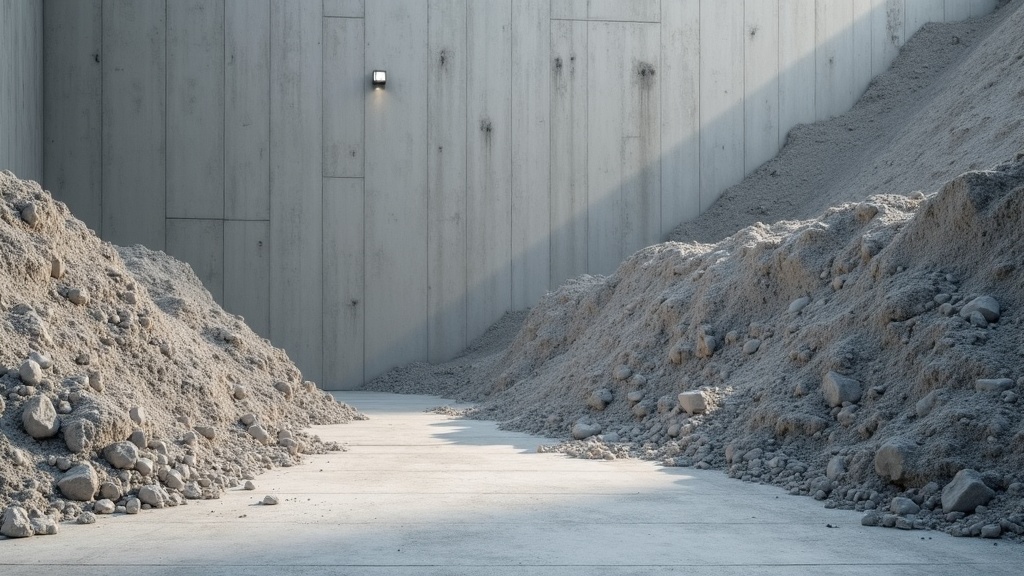
Underground mining operations generate significant amounts of excavated rock and tailings. To maintain subterranean stability, engineers pump specialized slurries back into the mine shafts. This practice, often referred to as concrete backfill, transforms waste materials into structural support. The primary goal is to create a solid mass that prevents rock bursts and supports the surrounding geological formations.
Recent academic literature emphasizes the ongoing evolution of these materials. According to industry researchers, ‘Recent papers have highlighted improvements in the design and application of cementitious backfills, focusing on their preparation, design, placement, and performance’ (Frontiers in Materials, 2022)[3]. These advancements allow mining companies to optimize their advances in cementitious backfill design for specific geological conditions.
The preparation of these mixtures involves combining tailings, water, and a binder. The resulting slurry must possess enough fluidity to travel through extensive pipeline networks without segregating. Once placed in the underground void, the mixture cures to form a rigid structure. This backfilled concrete not only secures the excavation but also reduces the surface footprint of tailings dams, making it a critical component of modern sustainable mining practices.
Controlled Low-Strength Material Applications
Beyond deep underground mining, similar principles apply to surface-level civil engineering projects. Controlled low-strength material, commonly known as CLSM, is a highly flowable mixture used for trench backfilling and pipeline support. Unlike traditional structural concrete, CLSM is designed to be excavatable in the future if utility repairs are required.
The engineering application results indicate that ‘the use of CLSM can achieve efficient and high-quality backfilling effects for pipeline trenches’ (Researchers, 2024)[1]. This makes concrete backfilling an ideal solution for municipal infrastructure projects where soil compaction is difficult to achieve. The high fluidity of the mixture allows it to self-level and fill every crevice around buried pipes, eliminating the need for mechanical vibration or tamping.
Achieving the right balance of strength and flowability requires precise proportioning. Studies show that an optimal mixture often contains around 9 percent cement content paired with a water content of 40-43 percent (National Center for Biotechnology Information / PMC, 2024)[1]. By carefully controlling these variables, engineers can produce a backfill cement that meets exact project specifications while minimizing material costs.
Environmental Benefits and Cement Replacement
The production of Portland cement is highly energy-intensive and accounts for a significant portion of global carbon dioxide emissions. To mitigate this environmental impact, the mining and construction industries are actively seeking alternatives to traditional binders. Incorporating supplementary cementitious materials into backfilling concrete formulations has emerged as a highly effective strategy for reducing the carbon footprint of large-scale projects.
Innovative binder technologies are now allowing operations to drastically cut their reliance on pure cement. Narain, a New Products and Applications Engineer at Graymont, notes that ‘We’re seeing anywhere between 30 to 50% reduction in the greenhouse gas emissions’ (Graymont, 2026)[2]. This substantial decrease is achieved by replacing a large portion of the cement with alternative materials like lime, fly ash, or slag.
Field and laboratory trials have demonstrated that these alternative binders do not compromise the structural integrity of the final product. In fact, case studies show that operations can achieve a 35-50 percent cement replacement without sacrificing the necessary compressive strength required for underground stability (Graymont, 2026)[2]. This shift toward greener formulations ensures that backfill concrete remains a sustainable choice for future infrastructure and mining development.
Slurry Preparation and Placement Techniques
The successful implementation of any backfill system depends heavily on the preparation and placement of the slurry. The mixing process must ensure a homogeneous distribution of all components to prevent weak spots in the cured mass. This technology mainly involves ‘adding an appropriate amount of binding material, water, and/or curing agent to a specific soil mass, and they are mixed evenly to form a mixture with a certain fluidity’ (Researchers, 2024)[1].
High-shear mixers are typically used at the surface batching plant to combine the dry tailings or soil with the liquid binder. The resulting slurry is then pumped through high-pressure pipelines to the placement site. In underground mining, the delivery system must navigate complex vertical and horizontal shafts. Engineers monitor the flow rate and pressure continuously to prevent pipeline blockages, which can cause costly delays and safety hazards.
Once the slurry reaches the void, it is deposited in layers, known as lifts. Allowing each lift to partially consolidate before adding the next helps manage the exothermic heat generated during the curing process. Proper temperature control is essential, as excessive heat can lead to thermal cracking within the concrete backfill mass. Through careful monitoring and precise mixing, operators ensure long-term subterranean stability.
Your Most Common Questions
What is the primary purpose of backfill concrete in mining?
The primary purpose is to fill underground voids left after mineral extraction. This process provides essential structural support to the surrounding rock mass, preventing surface subsidence and reducing the risk of rock bursts. It also allows mining companies to safely dispose of tailings underground rather than storing them in surface dams.
How does CLSM differ from traditional structural concrete?
Controlled low-strength material is specifically designed to have a lower compressive strength than structural concrete. This intentional reduction in strength ensures that the material remains excavatable using standard hand tools or light machinery. It is primarily used for utility trench backfilling where future access to buried pipes might be necessary.
Can backfill concrete reduce a mine’s carbon footprint?
Yes, modern formulations significantly reduce environmental impact. By incorporating alternative binders and supplementary cementitious materials, operations can replace up to half of the traditional Portland cement. This substitution directly lowers the greenhouse gas emissions associated with the production and transport of heavy cementitious materials.
What materials are typically mixed to create these slurries?
The base materials usually consist of mine tailings, waste rock, or natural soil. These aggregates are combined with water and a binding agent, which may include Portland cement, lime, fly ash, or specialized chemical curing agents. The exact proportions are tailored to meet the specific flowability and strength requirements of the project.
Comparing Backfill Methods
Selecting the right approach for void filling depends on the specific engineering requirements of the site. Different methods offer varying levels of strength, flowability, and environmental impact. Below is a comparison of three common techniques used in the industry today.
| Method | Strength | Flowability | Primary Use |
|---|---|---|---|
| Cemented Paste | High | Medium | Deep mine shafts |
| CLSM | Low | Very High | Utility trenches |
| Uncemented Rock | Variable | Low | Shallow voids |
While cemented paste provides the robust support needed for deep underground excavations, CLSM is preferred for surface utilities due to its high fluidity and future excavatability. Uncemented rock fill remains a cost-effective option for shallow areas where structural backfill concrete is not strictly required.
Practical Tips for Implementation
Implementing a successful backfilling operation requires attention to detail during both the batching and placement phases. Here are several best practices to ensure optimal results:
- Conduct regular slump tests to verify the fluidity of the slurry before it enters the pipeline network.
- Monitor the ambient temperature and adjust the curing agent dosage to prevent thermal cracking during the hydration process.
- Flush the delivery pipelines with water immediately after pumping to prevent residual material from hardening inside the tubes.
While our primary focus is on industrial engineering, our editorial team also covers a wide array of lifestyle topics. For readers interested in our broader content, we regularly publish guides on various cats and critters and pet health subjects, such as understanding why a cat’s back twitches. Maintaining a diverse knowledge base helps our community stay informed across multiple disciplines.
Wrapping Up
The evolution of backfill concrete has transformed how the mining and civil engineering sectors manage excavated voids. By leveraging advanced cementitious mixtures and alternative binders, operators can achieve superior subterranean stability while significantly reducing their environmental footprint. As material science continues to advance, we can expect even more sustainable and efficient grouting solutions to emerge. To explore more about industrial materials and our diverse range of editorial topics, visit our comprehensive industrial and lifestyle blog.
Learn More
- Experimental Study and Application of Controlled Low-Strength Material. National Center for Biotechnology Information / PMC.
https://pmc.ncbi.nlm.nih.gov/articles/PMC10890716/ - Graymont is Revolutionizing Mine Backfill with Cement Innovations. Graymont.
https://www.youtube.com/watch?v=LCVssrzBYqo - Advances in the Design and Implementation of Cementitious Backfills. Frontiers in Materials.
https://www.frontiersin.org/journals/materials/articles/10.3389/fmats.2022.964111/full