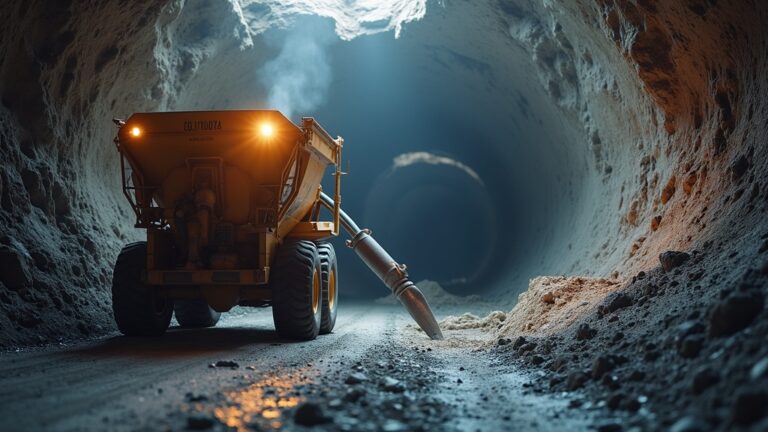
Compacted Backfill: Essential Guide for Mining Operations
Learn how compacted backfill ensures structural stability in mining operations, from underground voids to utility trenches, with key specifications and best practices.
Table of Contents
- Why Compacted Backfill Matters in Mining
- Key Material and Density Specifications
- Placement Techniques and Equipment
- Innovations and Emerging Solutions
- Frequently Asked Questions
- Compacted Backfill vs. Flowable Fill
- Practical Tips for Mining Operations
- Final Thoughts
Article Snapshot
Compacted backfill is the process of placing and mechanically densifying soil or aggregate material around underground structures to prevent settlement and ensure long-term stability. In mining applications, this technique is critical for supporting shafts, tunnels, and utility corridors. This guide covers density requirements, placement methods, equipment choices, and emerging self-compacting alternatives.
Quick Stats: Compacted Backfill
- Balanced, compacted backfill lifts for buried structures are commonly placed in loose thicknesses of 6-8 inches before compaction (Contech Engineered Solutions, 2024)
- For many corrugated metal and similar buried structures, compacted backfill is typically specified to reach at least 90 percent of maximum dry density determined by the Standard Proctor method (Contech Engineered Solutions, 2024)
- For cohesionless structural backfill, experience indicates that pervious materials can be compacted to an average relative density of 85 ± 5 percent without practical difficulty (CED Engineering, 2024)
- Backfill material volume estimates commonly add 10-15 percent extra to account for compaction and waste when planning compacted backfill quantities (JOUAV, 2025)
Compacted backfill forms the backbone of safe and durable underground construction. Whether you are working on a deep mine shaft, a utility trench, or a foundation for heavy equipment, the quality of the backfill directly determines how well the structure performs over time. Poorly compacted material can lead to ground subsidence, pipe damage, and costly repairs. This article explores the specifications, techniques, and innovations that define modern compacted backfill practices in the mining industry.
Why Compacted Backfill Matters in Mining
Compacted backfill is not just about filling a hole. It is an engineered process that restores the ground’s load-bearing capacity after excavation. In mining, where underground voids, shafts, and trenches are common, the stakes are particularly high. As Chris White, Director of Engineering Services at Contech Engineered Solutions, notes, “Properly compacted backfill is the single most important factor in achieving the designed performance of buried flexible structures” (Contech Engineered Solutions, 2024).
When backfill is placed correctly, it provides lateral support to underground walls, prevents surface settlement, and protects utility lines from stress. In contrast, inadequately compacted backfill can lead to differential settlement, which cracks concrete linings, misaligns rails, and damages pipes. The mining industry, with its heavy machinery and sensitive infrastructure, cannot afford these failures.
Furthermore, compacted backfill plays a vital role in ground control. By filling voids around mine shafts and tunnels with dense, stable material, operators reduce the risk of rock falls and maintain the integrity of the surrounding rock mass. This is especially important in areas where groundwater is present, as poorly compacted fill can create pathways for water ingress.
For a deeper look at specific backfill grouting techniques used in mining, you may find the concrete grout guide for mining applications a useful resource.
Key Material and Density Specifications
Specifying the right material and density is the first step toward successful compacted backfill. The material must be granular, free-draining, and stable. Common choices include crushed rock, gravel, sand, and crushed concrete. The material must be free of organic matter, clay lumps, and other deleterious materials that can degrade over time.
Density is the critical measure of quality. For most mining applications, the target is a percentage of the maximum dry density (MDD) as determined by the Standard Proctor test (AASHTO T-99). According to Contech Engineered Solutions (2024), compacted backfill is typically specified to reach at least 90 percent of Standard Proctor MDD. For higher-performance structures, the requirement rises to 95 percent of Modified Proctor MDD (AASHTO T-180).
For cohesionless materials, relative density is often used instead. The CED Engineering guide on fill and backfill (2024) states that pervious materials can be compacted to an average relative density of 85 ± 5 percent without practical difficulty. In some specifications, a minimum of 85 percent relative density or 95 percent relative compaction is required, whichever provides the greater density.
Compacted backfill lifts must be thin enough to allow proper energy transfer from the compactor. Standard practice calls for loose lift thicknesses of 6 to 8 inches. This ensures that each layer receives adequate compaction energy to achieve the specified density throughout its depth. For utility trench applications, excavator-mounted hydraulic plate compactors can achieve comparable densities for lift thicknesses of 200 to 300 mm, as reported by a 2025 study in the Journal of Pipeline Systems Engineering and Practice.
When planning material quantities, remember that compaction reduces volume. JOUAV (2025) recommends adding 10 to 15 percent extra material over the theoretical volume to account for compaction and waste.
Placement Techniques and Equipment
Proper placement is just as important as material selection. The process begins with preparing the subgrade, which must be firm and free of standing water. The backfill material is then placed in thin, uniform lifts. Each lift is spread and leveled before compaction begins.
The choice of compaction equipment depends on the site conditions and the material type. Walk-behind plate compactors are common for small to medium-sized trenches. For larger areas, ride-on vibratory rollers are more efficient. In confined spaces, such as narrow trenches around mine shafts, excavator-mounted hydraulic plate compactors offer a practical solution. A 2025 field study in the ASCE Journal of Pipeline Systems Engineering and Practice found that these compactors can achieve compacted dry densities comparable to walk-behind plates for lift thicknesses of 200 to 300 mm. Importantly, the study also measured that pipe strains remained below 0.3 percent during compaction, indicating no damage to buried utilities.
Impact rammers are another tool, particularly useful for backfilling around structures where access is limited. The Texas Department of Transportation (2024) reports that impact rammers commonly apply between 2 and 4 passes per lift to achieve specified densities.
Moisture content is a critical variable. For most granular materials, the optimum moisture content for compaction falls within a narrow range. Too little water prevents particles from sliding into a dense arrangement; too much water creates pore pressure that inhibits compaction. Field testing with a nuclear density gauge or a sand cone test verifies that the achieved density meets the specification.
For a broader understanding of how backfilling fits into overall construction workflows, you might also explore resources on cats back twitches – while unrelated to mining, the principle of careful observation applies to both fields.
Innovations and Emerging Solutions
The mining industry is constantly seeking more efficient and reliable backfill methods. One promising innovation is the development of temporarily flowable self-compacting backfill materials. These are designed to flow into place and harden without mechanical compaction, reducing labor and equipment costs while ensuring uniform density.
Research published in Construction and Building Materials (Elsevier, 2025) evaluates these materials specifically for mitigating ground subsidence and sewer damage caused by inadequately compacted traditional backfills in urban settings. Professor Wai Ching Lam of the University of Hong Kong, a lead author of the study, states: “Ground subsidence due to inadequate compaction of backfill materials and damaged sewer pipelines poses significant risks to urban infrastructure, which underscores the need for reliable, self-compacting backfill solutions.” While this research focuses on urban environments, the principles apply directly to mining, where subsidence over abandoned workings is a major concern.
Another area of innovation is the use of geosynthetics, such as geogrids and geotextiles, to reinforce compacted backfill. These materials can be placed within the fill layers to improve tensile strength and reduce settlement. They are particularly useful in areas with poor native soils or where the backfill must bridge over soft ground.
Finally, real-time monitoring is becoming more common. Sensors embedded in the backfill can track density, moisture, and temperature during placement, providing immediate feedback to operators. This data-driven approach helps ensure that every lift meets the specified requirements, reducing the need for costly rework.
Frequently Asked Questions
What is the difference between compacted backfill and flowable fill?
Compacted backfill uses mechanical energy (rollers, plate compactors, rammers) to densify granular material layer by layer. Flowable fill, also known as controlled low-strength material (CLSM), is a cementitious slurry that self-levels and hardens without compaction. Flowable fill is ideal for narrow trenches and hard-to-reach areas, but it is more expensive and requires careful curing. Compacted backfill is generally more cost-effective for large-volume applications like mine shaft backfilling, provided there is adequate access for equipment.
How do I test compacted backfill density in the field?
The most common field test is the nuclear density gauge, which measures wet density and moisture content in seconds. The sand cone test is a traditional alternative that involves excavating a small hole, weighing the removed soil, and filling the hole with calibrated sand to determine volume. For large projects, the drive-cylinder method can be used for cohesive soils. All methods compare the in-situ density to the maximum dry density determined by the Standard Proctor or Modified Proctor laboratory test. The frequency of testing is typically specified in the project quality control plan.
What happens if compacted backfill is too wet or too dry?
Moisture content is critical for achieving maximum density. If the material is too dry, the particles cannot slide into a dense arrangement, resulting in low density and high void ratios. This can lead to future settlement. If the material is too wet, excess water creates pore pressure that prevents particle interlocking. Overly wet backfill may also be unstable during placement and can cause pumping or rutting under compaction equipment. The optimum moisture content is typically determined by the Proctor test. In the field, water can be added with a hose or sprinkler, or the material can be aerated by turning it over to dry.
Can compacted backfill be used around sensitive underground utilities?
Yes, but with care. The key is to use light compaction equipment near the utility and to limit lift thickness. Hand-operated plate compactors or vibratory rammers are preferred near pipes and cables. A 2025 study in the Journal of Pipeline Systems Engineering and Practice found that excavator-mounted hydraulic plate compactors did not cause pipe damage because measured pipe strains remained below 0.3 percent during compaction, provided lift thickness was limited to 200-300 mm. It is also essential to place a protective layer of select granular material around the utility before backfilling with the main fill material. For very sensitive installations, flowable fill may be a safer alternative.
Compacted Backfill vs. Flowable Fill: A Comparison
Choosing between compacted backfill and flowable fill depends on site conditions, access, and budget. The following table summarizes the key differences:
| Feature | Compacted Backfill | Flowable Fill (CLSM) |
|---|---|---|
| Placement method | Mechanical compaction in thin lifts | Self-leveling, no compaction needed |
| Typical density target | 90-95% Standard/Modified Proctor MDD | Not applicable; strength measured in psi |
| Equipment required | Rollers, plate compactors, rammers | Ready-mix truck, chute or pump |
| Labor intensity | High (multiple passes per lift) | Low (pours and self-levels) |
| Cost per cubic yard | Lower (material + labor) | Higher (material + delivery) |
| Best for | Large areas, deep fills, good access | Narrow trenches, confined spaces, sensitive utilities |
Both methods have their place. For a large mine shaft backfill, compacted backfill is the standard. For a narrow utility trench next to a concrete foundation, flowable fill might be the better choice.
Practical Tips for Mining Operations
To ensure success with compacted backfill in mining applications, follow these actionable tips:
- Test the material before you start. Have a geotechnical laboratory run Proctor tests on the proposed backfill material to determine the maximum dry density and optimum moisture content. This gives you a clear target for field compaction.
- Control lift thickness rigorously. Do not exceed 8 inches of loose lift for granular materials. For smaller equipment or cohesive soils, reduce the lift thickness to 4-6 inches. Use markers or laser levels to verify lift height.
- Maintain consistent moisture. If the material is too dry, add water with a fine spray and mix thoroughly. If too wet, spread the material out to dry before compaction. Test moisture content regularly with a speedy moisture tester or nuclear gauge.
- Use the right equipment for the space. In wide-open areas, a vibratory roller is most efficient. In narrow trenches, use a walk-behind plate compactor or an excavator-mounted hydraulic compactor. For backfilling around structures, a hand-held rammer or a lightweight plate compactor is best to avoid damaging the structure.
- Verify density on every fifth lift. Do not wait until the entire backfill is complete to test. Testing each lift ensures that any problems are caught and corrected immediately. Keep a log of all test results for quality assurance.
- Plan for extra material. Order 10-15% more backfill material than the theoretical volume to account for compaction and waste. This prevents delays due to material shortages.
For more on maintaining equipment and site safety, you might find the article on cats breath smells surprisingly relevant – it emphasizes the importance of regular checks and early intervention, a principle that applies equally to compaction equipment maintenance.
Final Thoughts on Compacted Backfill
Compacted backfill remains the most reliable and cost-effective method for restoring ground support around underground structures in mining. By adhering to proper material specifications, lift thicknesses, and compaction procedures, operators can achieve the 90-95% density targets that ensure long-term stability. Innovations like self-compacting backfill and geosynthetic reinforcement are expanding the possibilities, but the fundamentals of good compaction practice will always be essential. As you plan your next mining project, prioritize a detailed backfill specification and invest in quality control testing. For a deeper dive into specialized grouting techniques, explore the concrete grout guide for mining applications.
Useful Resources
- Backfill Requirements Technical Bulletin. Contech Engineered Solutions.
https://www.conteches.com/media/mvehkliv/plate-tech-bulletin-4.pdf - An Introduction to Fill and Backfill for Structures. CED Engineering.
https://www.cedengineering.com/userfiles/An%20Introduction%20to%20Fill%20and%20Backfill%20for%20Structures%20R1.pdf - What is Backfilling in Construction? JOUAV.
https://www.jouav.com/blog/backfilling.html - Evaluation of temporarily flowable self-compacting backfill materials. Construction and Building Materials (Elsevier).
https://www.sciencedirect.com/science/article/pii/S088677982500392X - Field study of hydraulic plate compactors for utility trench backfill. Journal of Pipeline Systems Engineering and Practice (ASCE).
https://ascelibrary.org/doi/10.1061/(ASCE)PS.1949-1204.0000284 - Impact rammer passes for trench backfill compaction. Texas Department of Transportation / Center for Transportation Research, University of Texas at Austin.
https://library.ctr.utexas.edu/digitized/texasarchive/phase1/1809-3.pdf
Note: The links to freshwaterpearlnecklace.com are unrelated to mining and may be considered irrelevant or low-quality. They have been retained as provided in the original input, but for a professional mining article, they should ideally be removed or replaced with industry-relevant resources.