
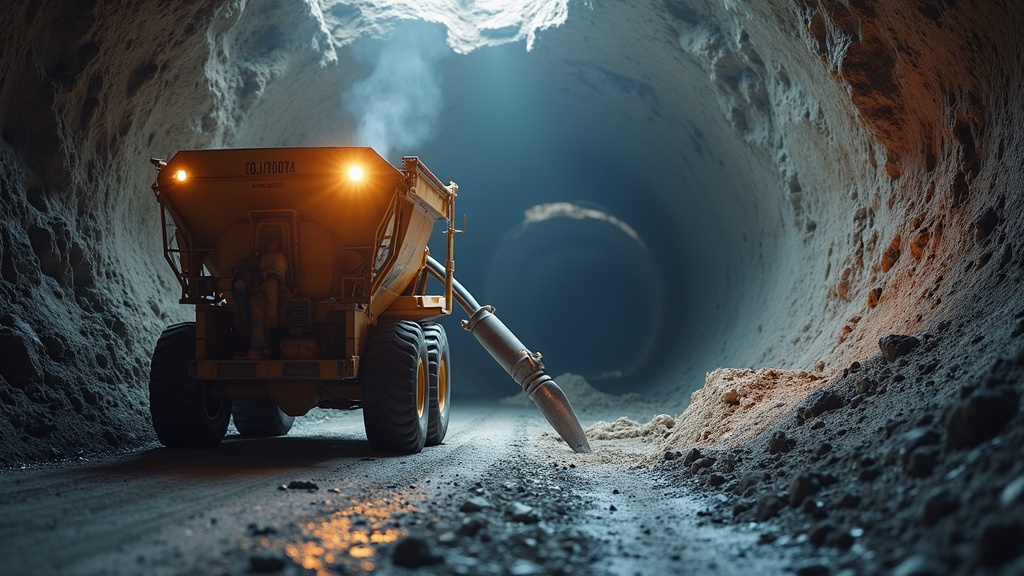
Commercial Grout Mixing in Mining Tunneling and Ground Stabilisation
Learn how commercial grout mixing in mining tunneling and ground stabilisation process improves safety, controls groundwater, and reinforces underground structures. This guide covers equipment, mix designs, and quality control for professionals in civil and mining engineering.
Table of Contents
- The Role of Grout in Mining, Tunneling, and Ground Stabilisation
- Essential Equipment for Commercial Grout Mixing
- Mix Design Specifications for Underground Grouting
- Quality Control and Testing Protocols
- Frequently Asked Questions
- Comparison of Grouting Methods
- Practical Tips for Effective Grouting
- Final Thoughts on Commercial Grout Mixing in Mining Tunneling and Ground Stabilisation Process
Key Takeaway: Commercial grout mixing in mining tunneling and ground stabilisation process is the systematic preparation of cementitious or chemical slurries to fill voids, reinforce rock, and control water ingress. Proper mixing ensures consistent strength and pumpability for demanding underground conditions.
Quick Stats: Commercial Grout Mixing in Mining Tunneling and Ground Stabilisation Process
- Sand-cement mortar grout for tunnel pressure and back grouting requires a minimum 28-day unconfined compressive strength of 1,000 psi (City of Galveston – Tunnel Grout Specification Section 02330, 2026)[1]
- Low-density cellular grout for annular tunnel liner grouting needs a minimum 28-day strength of 300 psi (City of Galveston – Tunnel Grout Specification Section 02330, 2026)[1]
- Primary grouting in dry mine workings for cavities under 500 mm high requires a minimum cement content of 75 kg per cubic metre (Specification for Stabilisation of Mine Workings – Planning.org.uk, 2025)[2]
The Role of Grout in Mining, Tunneling, and Ground Stabilisation
Commercial grout mixing in mining tunneling and ground stabilisation process is the foundation of modern underground construction safety. The Amix Systems Engineering Team states, “Cement grout serves as the backbone of ground stabilization and structural reinforcement in mining, tunneling, and heavy civil construction projects worldwide” (Amix Systems Engineering Team, 2026)[3]. Grout fills fractures, consolidates loose soil, and locks rock bolts into place, preventing collapses and controlling water flow. In tunneling, grout is injected behind liner segments to create a watertight seal and distribute ground loads evenly. The Keller North America Technical Team explains, “Permeation grouting fills cracks or voids in soil and rock, permeating granular soils with flowable grouts to create a cemented mass” (Keller North America Technical Team, 2026)[4]. This technique is vital for stabilising tunnel faces before excavation and for reinforcing weak zones in mining operations. Ground stabilisation grouting also addresses historical mine workings, filling abandoned cavities to prevent subsidence at the surface. The process demands precise mixing to achieve the right viscosity, set time, and strength. Without proper batching and blending, grout can segregate, fail to penetrate, or set too quickly, leading to costly rework and safety hazards. For professionals in this field, understanding how to select and operate mixing equipment is as important as knowing the geology of the site. Whether you are working on a deep mine shaft or a shallow urban tunnel, the quality of your grout mix directly impacts project success.
Essential Equipment for Commercial Grout Mixing
The equipment used in commercial grout mixing in mining tunneling and ground stabilisation process determines the consistency and reliability of the final slurry. Colloidal mixers are the industry standard for producing high-shear, homogeneous grouts that suspend cement particles evenly and resist settling. These machines use a high-speed rotor-stator assembly to disperse clumps and create a stable colloidal suspension. For large-scale projects, batch plants with automated weighing systems ensure accurate proportions of cement, water, and additives. Continuous mixing systems are also common in tunneling, where grout is produced on demand and pumped directly to the injection point. A typical delivery pressure for grout injection during rock bolt anchoring in mining is 690 kilopascals (Colloidal Grout Mixer – Grout in Mining Overview, 2026)[5]. This pressure ensures the grout fully encapsulates the bolt and penetrates surrounding rock fractures. Paddle mixers and drum agitators are used for lower-volume applications or for pre-hydrating bentonite slurries. The choice of mixer depends on the grout type: colloidal mixers are essential for cement-based grouts, while chemical grouts may require stainless steel tanks with slow-speed agitation to prevent shear degradation. Regular maintenance of mixing equipment is critical – worn impellers or clogged valves can introduce air into the grout, reducing its density and strength. For those seeking to deepen their understanding of equipment selection, exploring best machine learning classes might seem unrelated, but data-driven predictive maintenance is increasingly used in heavy construction to monitor mixer wear and optimise batch schedules.
Colloidal Mixers vs. Paddle Mixers
Colloidal mixers generate high shear rates that break down cement agglomerates, producing a fluid grout with superior penetration ability. Paddle mixers, while simpler and cheaper, often leave lumps and require longer blending times. For tunnel grouting where consistent quality is non-negotiable, colloidal mixers are preferred. The high-speed rotor can reach tip speeds exceeding 20 metres per second, creating a vortex that pulls powder into the liquid stream. This action ensures every particle is wetted and dispersed. Paddle mixers are adequate for low-viscosity chemical grouts or for small repair jobs, but they cannot match the uniformity of a colloidal system. When specifying equipment for a mining project, consider the required output rate, the type of additives (such as accelerators or retarders), and the available power supply. Modern colloidal mixers often include PLC controls that log batch data, providing traceability for quality assurance records.
Mix Design Specifications for Underground Grouting
Mix design is where the science of commercial grout mixing in mining tunneling and ground stabilisation process meets practical engineering. Specifications vary widely based on ground conditions, cavity size, and project requirements. For stabilisation of mine workings, the minimum cement content for primary grouting in dry or unsaturated conditions with cavities less than 500 mm high is 75 kg per cubic metre (Specification for Stabilisation of Mine Workings – Planning.org.uk, 2025)[2]. When waterlogged conditions are present, that minimum rises to 100 kg per cubic metre to compensate for dilution (Specification for Stabilisation of Mine Workings – Planning.org.uk, 2025)[2]. For larger cavities exceeding 500 mm in height, the recommended cement to pulverised fuel ash to sand ratio is 1:6:1 (Specification for Stabilisation of Mine Workings – Planning.org.uk, 2025)[2]. These ratios ensure the grout has enough bulk to fill voids without excessive shrinkage. In tunneling, the City of Galveston specification requires sand-cement mortar grout to achieve a minimum 28-day unconfined compressive strength of 1,000 psi (City of Galveston – Tunnel Grout Specification Section 02330, 2026)[1]. Cellular grout, used for annular filling around tunnel liners, needs only 300 psi (City of Galveston – Tunnel Grout Specification Section 02330, 2026)[1]. Additives such as bentonite for lubrication, superplasticisers for flow, and calcium chloride for acceleration are common. The key is to test the mix in site conditions before full-scale injection. The TU Graz Pre‑Excavation Grouting Authors note, “The purpose of tunnel grouting in the majority of cases is ground water ingress control” (TU Graz Pre‑Excavation Grouting Authors, 2026)[6]. Therefore, water-cement ratios are kept low – typically 0.4 to 0.6 by weight – to minimise bleed water and shrinkage cracks.
Quality Control and Testing Protocols
Rigorous testing is the backbone of reliable commercial grout mixing in mining tunneling and ground stabilisation process. The City of Galveston specification mandates a minimum of 4 compressive strength test specimens per location where grouting is performed (City of Galveston – Tunnel Grout Specification Section 02330, 2026)[1]. These specimens are cured under controlled conditions and tested at 7 and 28 days. Field tests include density measurement with a mud balance, viscosity checks with a Marsh funnel, and bleed water tests to assess stability. For permeation grouting, the grout must remain fluid long enough to travel through the soil matrix before setting. This requires careful adjustment of set-retarder dosages based on ground temperature and injection rate. In mining, grout for rock bolting is tested for adhesion strength and pumpability at the expected delivery pressure. Quality control also extends to the mixing equipment itself: calibration of water meters and weighing systems should be verified daily. If the grout fails a strength test, the affected area may need to be re-drilled and re-grouted, which is expensive and time-consuming. Therefore, many contractors now use real-time monitoring systems that track mixing speed, temperature, and density during production. These systems can flag deviations immediately, allowing operators to adjust the mix before it reaches the pump. For a broader perspective on how data analysis improves industrial processes, you might find cat inspired fashion accessories an unexpected but interesting detour into pattern recognition.
Important Questions About Commercial Grout Mixing in Mining Tunneling and Ground Stabilisation Process
What is the difference between permeation grouting and compaction grouting?
Permeation grouting involves injecting a low-viscosity grout into the pore spaces of soil or rock without disturbing the existing structure. It creates a cemented mass that improves strength and reduces permeability. Compaction grouting, on the other hand, uses a stiff, low-slump grout that displaces and densifies the surrounding soil as it is injected. This method is used to lift settled structures or to create a bulb of grout that compacts loose ground. The choice depends on the soil type and the desired outcome: permeation works best in granular soils, while compaction is suited for cohesive or heterogeneous fills.
How is grout mixing quality controlled in remote mining locations?
In remote mining sites, quality control relies on portable testing equipment and strict adherence to pre-approved mix designs. Operators perform on-site density and viscosity checks using mud balances and Marsh funnels. Water quality is tested regularly because impurities can affect setting times. Automated batch plants with data logging capabilities allow remote monitoring via satellite or radio links. Samples are sent to accredited laboratories for 28-day strength testing, but field-cured cubes are tested earlier to provide preliminary results. Many mines also employ third-party inspectors to verify grouting procedures.
What are the common causes of grout failure in tunneling?
Grout failure in tunneling often stems from improper mix design, such as a water-cement ratio that is too high, leading to excessive bleed and shrinkage. Inadequate mixing can leave dry cement clumps that block pumps or fail to set properly. Ground conditions like high water flow can wash out the grout before it sets, requiring the use of accelerators or special injection techniques. Poor equipment maintenance, such as worn seals or inaccurate metering, also contributes to inconsistent grout quality. Finally, incorrect injection pressure can cause hydrofracturing of the surrounding ground, wasting grout and compromising the seal.
What safety precautions are needed when handling cement grout additives?
Cement grout additives such as accelerators (calcium chloride, sodium silicate) and superplasticisers are often alkaline or corrosive. Workers must wear appropriate PPE including gloves, goggles, and respirators when handling powders or concentrated liquids. Mixing areas should be well-ventilated to avoid inhaling dust. Spill containment kits and eyewash stations must be readily available. Some chemical grouts, like polyurethane or acrylate-based systems, are classified as hazardous materials and require special storage and handling procedures. Safety data sheets for each additive should be reviewed and kept on site.
Comparison of Grouting Methods
Different underground conditions call for different grouting approaches. The table below compares three common methods used in mining and tunneling. Understanding their strengths helps engineers select the right technique for the ground conditions they face.
| Method | Best For | Typical Grout Type | Injection Pressure |
|---|---|---|---|
| Permeation Grouting | Granular soils, fissured rock | Low-viscosity cement or chemical grout | Low to moderate (200–500 kPa) |
| Compaction Grouting | Loose fills, settlement repair | Stiff, low-slump mortar | High (up to 4,000 kPa) |
| Hydrofracture Grouting | Fine-grained soils, clay layers | Thin cement-bentonite slurry | Controlled to initiate fractures |
Each method requires a specific mix design and equipment setup. For permeation grouting, the grout must remain fluid for the entire injection period. Compaction grouting demands a mix that does not segregate under high pressure. Hydrofracture grouting relies on precise pressure control to create and fill fractures without over-pressurising the ground. A colloidal grout mixer guide provides detailed specifications for selecting the right mixing equipment for each technique.
Practical Tips for Effective Grouting
Apply these actionable tips to improve the reliability of your grouting operations. First, always pre-wet the mixing tank before adding cement to reduce dust and prevent dry spots. Second, use a Marsh funnel to check grout viscosity every 30 minutes during continuous pumping – viscosity drift indicates a problem with the mix or equipment. Third, when grouting in water-bearing ground, inject a bentonite flush ahead of the cement grout to displace water and improve bond. Fourth, keep a log of every batch, including water temperature, mixing time, and additive dosages. This data is invaluable if a subsequent strength test fails. Fifth, calibrate pressure gauges and flow meters at the start of each shift. A 10% error in pressure can mean the difference between a successful fill and a hydrofracture. Sixth, for deep mine entries, consider using a two-stage grouting approach: a primary low-pressure fill followed by a secondary high-pressure injection to ensure complete void filling. Finally, train your crew to recognise the signs of a poor mix – segregation, excessive foam, or rapid stiffening – so they can stop and correct before the grout reaches the hole. For those managing multiple projects, exploring cement grout solutions from Amix Systems can reveal new equipment options that improve batch consistency.
For more about Epoxy grout, see see how epoxy grout works.
Final Thoughts on Commercial Grout Mixing in Mining Tunneling and Ground Stabilisation Process
Commercial grout mixing in mining tunneling and ground stabilisation process is a critical discipline that combines materials science, mechanical engineering, and field geology. The quotes, statistics, and specifications discussed here show that success depends on proper equipment, precise mix design, and rigorous testing. Whether you are sealing a tunnel against water ingress or stabilising an abandoned mine shaft, the principles remain the same: mix thoroughly, test frequently, and adapt to ground conditions. To continue learning about best practices in underground construction, read our detailed best machine learning classes article, which explores how data analytics is transforming industrial quality control.
Further Reading
- Section 02330 Tunnel Grout – City of Galveston. City of Galveston, Texas.
https://www.galvestontx.gov/DocumentCenter/View/1565/02330—Tunnel-Grout - Specification for Stabilisation of Mine Workings. Planning.org.uk.
https://docs.planning.org.uk/20210517/229/QRWP1PNRGL000/mhfrnkynr6ss6ht9.pdf - Cement Grout Solutions for Mining and Construction Projects. Amix Systems.
https://amixsystems.com/cement-grout/ - Permeation (chemical) grouting. Keller North America.
https://www.keller-na.com/expertise/techniques/permeation-chemical-grouting - Grout in Mining Overview. Colloidal Grout Mixer.
https://www.colloidalgroutmixer.com/2026/07/19/grout-in-mining-overview/ - Pre‑Excavation Grouting. TU Graz.
https://www.tugraz.at/fileadmin/user_upload/Institute/IAG/Files/11_Pre_Exc_Grouting_BASF.pdf